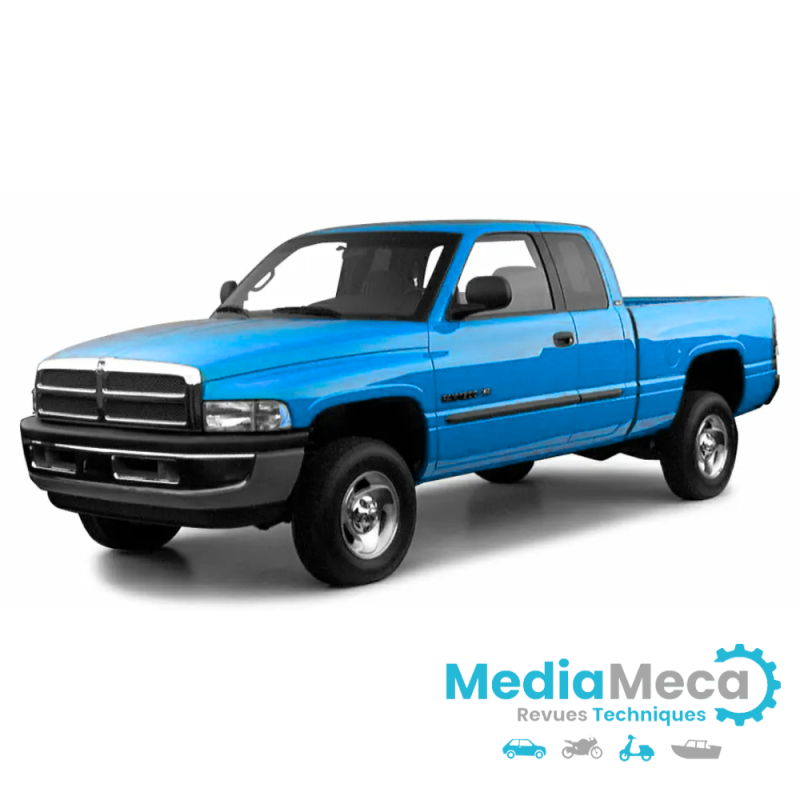


Workshop manual for DODGE
Models: RAM
 Quality Guarantee on our Documents
Each document is carefully selected to provide reliable and accurate information.
 Instant access after purchase
Receive your documentation in seconds after payment, no waiting!
 Documentation for all vehicle types
Easily find the guides suited to your vehicle, whether classic or modern.
MODEL:
.
.
RAM 1500 Type: BR / BE
.
.
ENGINES: Petrol and Diesel
.
BODYWORK:
.
TRANSMISSIONS:
Ultra-complete and very understandable documentation with lots of drawings.
Language: English
2889 Pages Manual pdf
Edition date : 2001
Vintages : 2001
.
CONTAINS electrical diagrams and tightening torques
COMPLETE VEHICLE DEALING
.
.
.
.
.
.
.
The technical characteristics of each product appear in the “technical sheet” tab as well as their “paper or CDROM” support.
you will find all the technical terms used in the advertisements in the “how to choose” part of the site
.
The web talks about it:
.
.
.
.
In 1993, Dodge had 7% of the pickup truck market share, and nearly half of those had
Cummins diesel engines, some buyers said they weren't buying a Dodge, but a Cummins with a
Dodge wrapped around.
Suddenly, Dodge dropped a bomb - the 1994 Dodge Ram. Its styling was new and different, with a
sleek that mimicked heavy trucks, it was more aerodynamic and had much better designed interiors
than competitors. It also offered the highest chassis loads and towing capacities
of the industry. Dodge's full-size pickup truck market share has tripled in just a few years.
1994 dodge ram The new Dodge Ram pickup had a long list of industry firsts, with the cab
roomiest standard, first reclining seats in a regular cab pickup and longest
seat rail travel.
Magnum engines had more horsepower and torque than competing engines, and by midyear,
they were joined by a V-10 producing 300 horsepower and 450 pound-feet of torque. The new Ram had
also the first factory installed PTO adapter on a 4x2 truck with a transmission
automatic, and the best-in-class Cummins turbodiesel continued.
Styling packages started with the base model LT, with a WS (Work Special) available on 1500
microphones only. All pickups could get the ST group, and all models could get the
Laramie SLT.
The new Ram, coded Phoenix, was supposed to be much more conventional, although the styling was similar.
According to a retired Chrysler engineer, there were few Dodge truck engineers left in the
“main truck” of the company, and with a low market share and an uncertain future, the group would have
been a “dumping ground” for unwanted employees.
Everything changed with François Castaing and Bob Lutz restarting the project (originally coded T300) from scratch.
Everything has been examined in depth - including the suspensions. Engineer Bob Sheaves wrote:
The 1994 Dodge Ram (BR) was fully digital. There was no reason for clay models.
From the start of the program at JTE, we worked strictly in CATIA with 3D surfacing and
solid, no clay was needed, as CATIA built exact full-scale models of the panels
and structure. The body shells of the first article (including the complete body, the bed and all the
closures and structures) were directly cut from the 3D mathematical data. From the first panel to
upon completion, each part fits properly. It was the first time this was done in the world by
any manufacturer, for any product - even Dassault said it couldn't be done.
I was way behind on this pendant design when [my design] was first shown
to management. No one ever thought about the L/R (shows you a little bit of what management really knew about
global industry). I had 15 different vehicles for competitive analysis available during the
development of the 1994 Dodge Ram 4x4 suspension. The only reason the link/coil was
used is that it proved to be cheaper and better performing than the leaf spring configuration that
I conceived.
Independent designs (there were 27 different combinations of independent designs evaluated,
but only two were building, if I remember correctly, a coil spring design and a
torsion bar suspension) generally performed better on the road, and a few performed better
on the road, but cost was the determining factor over performance gains.