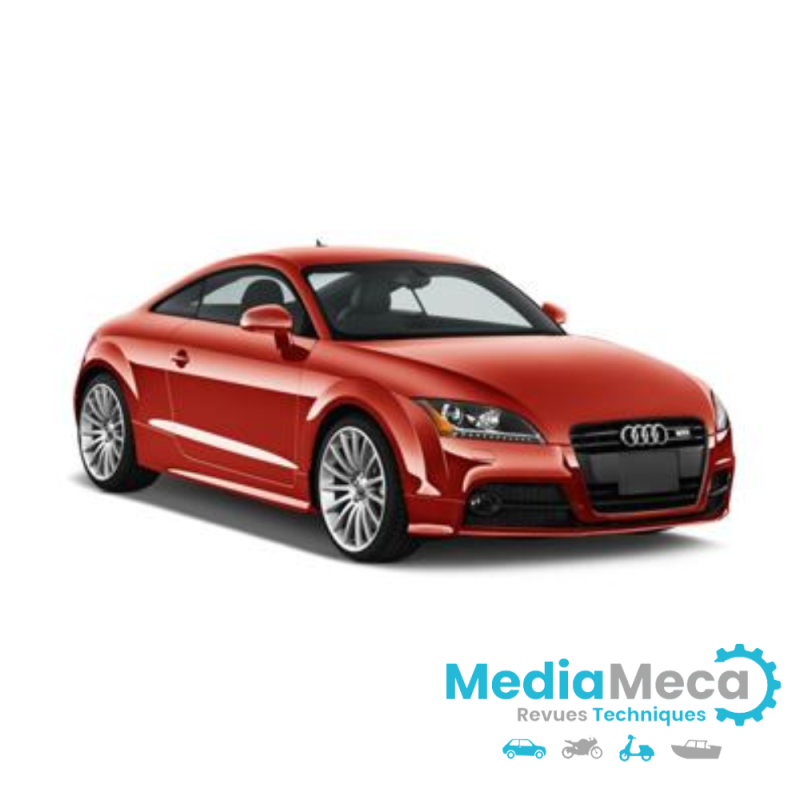

Workshop manual for Audi
Models: TT + TTS + TT RS - 2007 to 2014
 Quality Guarantee on our Documents
Each document is carefully selected to provide reliable and accurate information.
 Instant access after purchase
Receive your documentation in seconds after payment, no waiting!
 Documentation for all vehicle types
Easily find the guides suited to your vehicle, whether classic or modern.
MODEL:
.
.
TT + TTS + TT RS Type: 8J
.
.
ENGINES: Petrol and Diesel
.
BODYWORK:
.
TRANSMISSIONS:
Ultra-complete and very understandable documentation with lots of drawings.
Language: English
Manual of 1920 Pages pdf
Edition date :
Vintages covered : from 2007 to 2014 inclusive
.
CONTAINS electrical diagrams and tightening torques
COMPLETE VEHICLE DEALING, ALLOWS THE REPAIR AND MAINTENANCE OF YOUR VEHICLE
.
.
.
.
.
.
What product do I need?
Workshop manual
The workshop manual is used by mechanics, it is an ultra-detailed technical review from the manufacturer. It is used to repair a vehicle down to the smallest detail. It includes chapters dealing with each part of the vehicle but also electronic fault codes and tightening torques.
Spare parts manual
This is the spare parts manual, it contains your entire vehicle in spare parts. You will find on one side the exploded view and on the other the nomenclature with the designations and references. It will help you understand the assembly of the part to be dismantled, to be able to reassemble in the right direction without forgetting anything and to order the right parts with the right references.
User manual
It is delivered with your vehicle when you purchase it, it contains basic information for proper use of the controls. You will find the basics of routine maintenance
Bodywork manual
This manual is intended for bodybuilders as its name suggests, it gives all the factory instructions for restoring the chassis and body parts of your vehicle to their original condition.
If in doubt, call our hotline (number at the bottom of the site's home page)
.
.
.
.
.
.
The technical characteristics of each product appear in the “technical sheet” tab as well as their “paper or CDROM” support.
you will find all the technical terms used in the advertisements in the “how to choose” part of the site
.
.
.
.
The web talks about it:
.
Breakthrough products are becoming increasingly rare in the modern world of enhancement
progressive. But at the turn of the millennium, Audi achieved this goal with its premier TT
generation. Making the transition from the motor show concept almost completely unchanged
to the reality of production, the original TT was the shaky product of a very
confident and who changed many perceptions.
The problem with these products is always tracking. How do you improve something that,
despite some weaknesses, proved to be a resounding success? With the second TT
generation, Audi thinks it has found a simple solution: you erase these defects and you keep
the very essence. Did he succeed?
TT is all about style. The courageous design of the first generation Bauhaus
contributed significantly to its overall appeal. But time and fashion have evolved.
While the new Audi TT 2.0 TFSI retains the narrow window line, arched roof and
the basic silhouette of its predecessor, the details are rather different and the dimensions
stretched.
The latter is particularly evident at the rear, where the rounded rump has been considerably
extended not only to allow more storage space under the tailgate,
but also to incorporate an electronic spoiler.
The car also appears significantly wider than the previous model, which, combined with its
low height, gives it a very stocky muscular appearance, reinforced by these flared wheel arches
which are so perfectly fulfilled by 18-inch alloy wheels. Overall,
the second generation of TT may not have the look of the original,
but it's arguably a more balanced and cleaner design.
Audi has had an impressive run when it comes to cabins, and the TT doesn't disappoint.
Featuring extensive contributions from South African interior designer Oona Scheepers,
The perceived quality and stylish design are unmatched by any other coupe rival.
The general appearance is similar to previous models, but the different elements come from
less clearly from the VW parts bin.
The facade is constructed primarily from an expensive soft-touch (and feel) plastic,
and convincing aluminum inserts add a touch of class. Ventilation outlets
pod-shaped circulars from the previous model were retained, but now there are
more. The instrumentation, housed in deep dials with a digital display between them,
is superb.
For the keen driver, what stands out most is the driving position.
Default seat position is lower, transmission lever is placed higher
and the steering wheel benefits from generous tilt and reach adjustment.